
Voltage (CV) or current (CC)
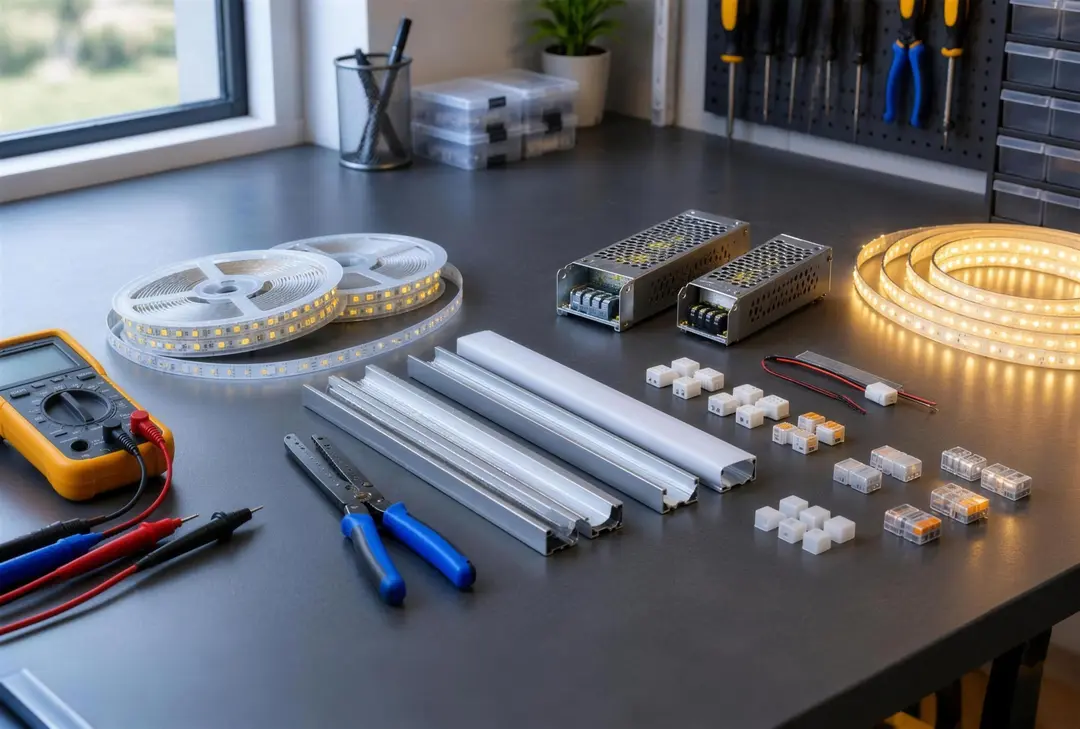
A constant voltage (CV) power supply holds 5, 12, 24 or 48 V, and the current depends on the load. This is what is usually called a power supply. It feeds anything that has its own resistors or drivers: LED strip, neon, signage modules, 48 V magnetic tracks, 12 V luminaires.
A constant current (CC) driver holds the current — 300, 350, 500, 700, 1 050 mA and so on — while the voltage floats within a range, for example 24–42 V. It feeds luminaires with bare LEDs: panels, downlights, floodlights, track spotlights, COB arrays. An LED is a current-driven device: at a fixed current it shines steadily, and without current limiting it burns out in seconds.
A quick check: “12 V” or “24 V” on the load — a CV power supply of the same voltage. “350 mA, 30–36 V” — a 350 mA driver whose range covers 30–36 V.
Voltage: 12, 24 or 48 V
The power supply voltage must match the voltage of the load. If the system has not been chosen yet:
- 24 V — the best choice for most lighting: half the current of 12 V, thinner wires, a lower voltage drop, runs of up to 10 m from one feed point.
- 12 V — sections up to 5 m, automotive and off-grid systems with a 12 V battery.
- 48 V — magnetic tracks and long runs.
- 5 V — addressable WS2812 strips and LED screen modules.
Power: the formula and the 20 % margin
Add up the power of the load and add 20 %: a power supply at its limit runs hotter and lasts less, the inrush current of a long strip is above the rating, and capacitors lose capacitance over time.
PPSU = Pload × 1.2
For a strip, Pload = length × power per metre; for luminaires, the sum of their powers.
Example 1. A ceiling cove: 8 m of 24 V strip at 14.4 W/m = 115 W; × 1.2 = 138 W → a 150 W power supply.
Example 2. A magnetic track: 6 spotlights of 12 W + a 24 W module = 96 W; × 1.2 = 115 W → a 120 W 48 V driver, or 150 W straight away if you plan to add luminaires.
Example 3. A sign: 60 modules of 0.72 W at 12 V = 43 W; × 1.2 = 52 W → a 60 W power supply.
Too much headroom is also harmful: a 350 W power supply on a 30 W strip runs inefficiently, and its fan makes noise for nothing. The optimum load is 60–80 % of the rating.
Housing and IP for the mounting location
| Type | IP | Where | Features |
|---|---|---|---|
| Open, perforated housing | IP20 | Dry niches, cabinets, behind plasterboard with air flow | The best cooling, the cheapest watt; from 200 W — with a fan |
| Sealed, cast aluminium | IP67 | Outdoors, bathrooms, signs, dusty niches | Heat leaves through the housing — do not wall it in; more expensive |
| Ultra-slim | IP20–IP44 | Furniture, profiles, cabinets, behind a skirting board | 15–20 mm, silent, usually up to 100–150 W |
| DIN rail | IP20 | Distribution board | Several circuits from one place, easy maintenance |
| Plug-in adapter | IP20 | Small lighting set-ups up to 60 W | Plugs into a socket, no installation |
Sealed does not mean “anywhere”: without air movement it runs hotter than an open unit and lasts less. Every power supply needs 5–10 cm of free space and no more than 40 °C around it.
Wires, losses, protection
On a 12 V line each metre of 0.75 mm² wire at 5 A eats about 0.25 V, and 4 m already takes an eighth of the brightness. So the power supply is placed close to the strip, above 5 A a 1.5 mm² wire is used, and strips longer than 5 m are fed from both ends or from the middle. At 24 V the losses are four times lower.
The 220 V input needs a circuit breaker. Good power supplies are protected against short circuit, overload and overheating and recover by themselves. If the power supply “clicks” and the strip blinks, the overload protection has tripped: the load is above the rating.
Dimming
A strip on a CV power supply is dimmed with a 12–24 V PWM dimmer between the power supply and the strip — with a remote control, a touch panel or Wi-Fi. The power supply itself is an ordinary one.
Luminaires on CC drivers need a dimmable driver: TRIAC (for an ordinary wall dimmer), 0–10 V, DALI or PUSH. A non-dimmable driver on a wall dimmer flickers or fails.
When to pay for Mean Well
Budget power supplies work fine in furniture and closed niches at a moderate load. Mean Well and equivalents of the same class are needed where a failure is expensive: in a ceiling that would have to be taken apart, in a sign high up on a façade, outdoors with temperature swings, on sites with a warranty to the client.
The LRS (open, 35–350 W), LPV (sealed, 20–150 W) and HLG (sealed with dimming, 40–600 W) series: stable voltage, a full set of protections, a manufacturer’s warranty of 2–7 years. The price difference pays for itself with the first call-out to a site that you avoid.
Checklist
- Strip, neon, 48 V track — a CV power supply; a luminaire marked in mA — a CC driver.
- The power supply voltage equals the load voltage.
- Power = load × 1.2, rounded up to a standard rating.
- IP20 — dry with air flow, IP67 — moisture; free space around it — for every unit.
- Long runs — 24 V, 1.5 mm² wire, feed from both ends.
- The dimmer goes between the power supply and the strip; the driver must be dimmable.