Carlamp
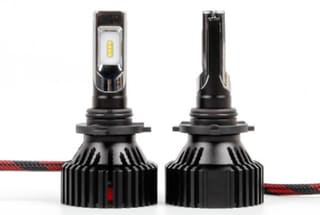
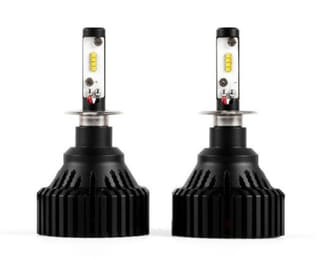
Лампочка для авто H3 Carlamp LED Smart Vision 8000lm 9-16V 30W 6500K комплект 2шт
30 Вт · 6500 K · 9–16 В
UAH 2,033In stock
Electrical
Energy
Lighting
LED screens and signage
Other sections
Buying guides
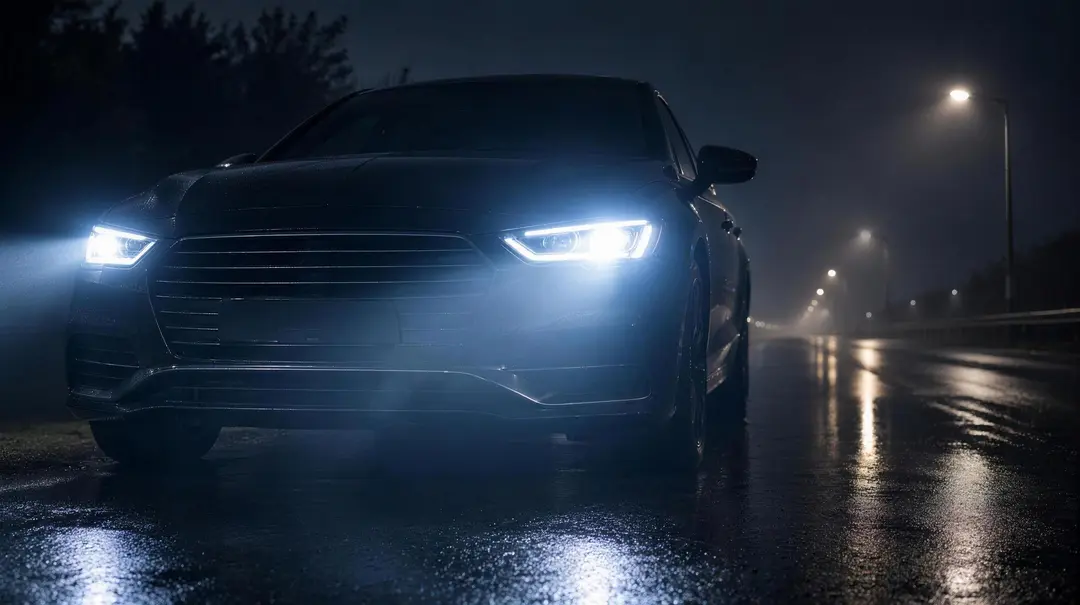
An LED bulb in place of a halogen one gives either clean white light or a blurred patch that dazzles oncoming drivers. The outcome depends on the base, the geometry of the LEDs and the type of headlight optics. Five selection steps, and an honest word on legality.
The base type is given in the owner’s manual, on the halogen bulb itself and in online bulb finders by make and year.
| Base | Where it is fitted | Feature |
|---|---|---|
| H4 | Dipped and main beam in one bulb | A halogen bulb has two filaments, an LED one two blocks of LEDs; the most demanding in terms of geometry |
| H7 | Dipped or main beam in separate headlights, most European cars of the 2000s | The most popular; many variants of the retaining clip — check the adapters |
| H1 | Main beam, fog lights, older projector headlights | A slim base, little room for a heat sink in the headlight |
| H11 / H8 / H9 | Dipped beam and fog lights on Japanese, Korean and American cars | One base with a twist-lock mount |
| HB3 (9005) | Main beam | American standard |
| HB4 (9006) | Dipped beam and fog lights | Similar to HB3, but not interchangeable |
| H3 | Fog lights | A base with a wire lead |
The optics decide whether an LED will work at all. A round lens 5–8 cm across behind the glass means a projector (lens) headlight; a mirrored bowl with a faceted surface means a reflector headlight.
A projector forms the cut-off line with a shield inside the module and forgives inaccuracies in the light source: almost any good LED bulb will give a sharp cut-off in it. This is the safest replacement.
A reflector is designed for a filament 4–5 mm long at a precisely defined point. An LED bulb has to replicate it: LEDs up to 1 mm in size in a row on two opposite sides of a thin board, exactly at the height of the filament. Wide LEDs or three or four emitting sides scatter light upwards and blur the cut-off: you can see well, oncoming drivers are dazzled. You need bulbs marked as reflector-compatible, with a board that can be rotated by a few degrees.
The 10 000, 20 000 and even 40 000 lm on the packaging are a theoretical total for a pair of bulbs without losses. A halogen H7 gives about 1 500 lm, a good LED bulb 1 800–2 500 lm of real flux at 25–35 W: noticeably brighter, while the headlight stays controllable. Bulbs claimed at 60–80 W overheat in a closed headlight and degrade within a few months.
Colour — 5500–6000 K: clean white, road markings read well. Do not take 6500 K and above: in rain and fog bluish light reflects off the droplets and worsens visibility. 4300 K looks like a good halogen and is the least tiring.
LEDs do not like temperatures above 85 °C, and in summer a headlight can reach 60 °C before it is even switched on. A fan is compact and cools well, but it wears out and can be audible in silence. A passive heat sink or copper “braids” are silent and last for ever, but they are bulkier.
Measure the distance from the base to the rear cover of the headlight. If the cover will not close, there are extended rubber covers — they keep the headlight sealed.
Most cars made after 2005 monitor their bulbs by current. An LED draws a third of the current of a halogen bulb, and the on-board computer decides the bulb has blown: an error on the dashboard, flickering, or the bulb does not switch on.
Load resistors heat up to 100 °C — fix them to metal, away from plastic and wiring. If in doubt, send us the make, model and year, and we will tell you whether a canceller is needed.
The UNECE regulations under which headlights are certified do not provide for an LED bulb in a headlight designed for halogen. Only a few models have been officially approved, for specific cars, in some EU countries. In Ukraine such a replacement is formally not certified, and the driver is responsible for making sure the headlights do not dazzle others.
In practice:
See in the catalogue
Carlamp
30 Вт · 6500 K · 9–16 В
DriveX
45 Вт · 5500 K · 24 В
DriveX
90 Вт · 6000 K · 9–32 В
Solar
50 Вт · 6500 K · 12 В
DriveX
47 Вт · 5500 K · 12 В
Carlamp
30 Вт · 6500 K · 9–16 В
Buying guides

A track replaces a chandelier where furniture gets moved around and light needs to be directed. Below: how a 220 V single-phase system differs from a 48 V magnetic one, and how to work out the luminaires and the driver for a 20 m² living room.
Read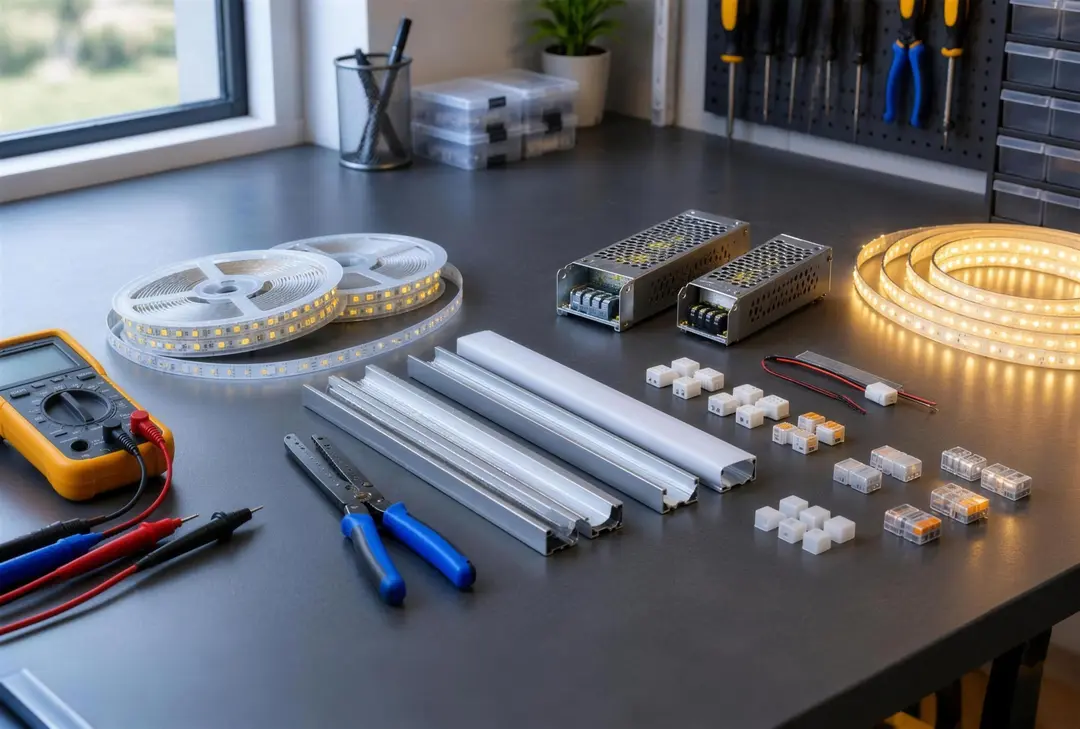
Half of all “burnt-out strips” come down to the wrong power supply. The difference between constant voltage and constant current, power with a 20 % margin, the housing for the mounting location and when it is worth paying for Mean Well.
ReadContact