



Feron
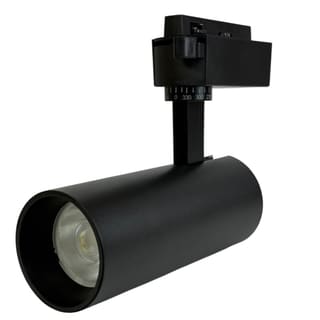
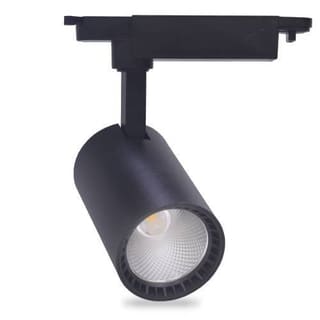
Черный светильник для треков 20W светодиодный 4000К нейтральный белый свет
20 Вт · 4000 K · 230 В
UAH 746In stock
Electrical
Energy
Lighting
LED screens and signage
Other sections
Buying guides
A track replaces a chandelier where furniture gets moved around and light needs to be directed. Below: how a 220 V single-phase system differs from a 48 V magnetic one, and how to work out the luminaires and the driver for a 20 m² living room.
A busbar track is an aluminium profile with copper conductors. A luminaire is fitted through an adapter at any point on the track and can then be moved, turned or removed without tools or an electrician. Tracks are joined into any shape with connectors — straight, L, T and X — and power is fed through a live end at one end.
Single-phase, three-phase and magnetic systems differ in their contacts and voltage and are not compatible with one another. The system is chosen once, at the start.
The most common and affordable option. The track is fed at 220 V, with a driver in each luminaire. Surface mounting on the ceiling or on suspensions takes an hour and needs no embedded parts.
Suits flats with an ordinary ceiling, shops, studios and cafés.
A driver converts 220 V into 48 V DC and is hidden above the ceiling; the luminaires are held by magnets. The 20–35 mm profile is set flush into plasterboard, installed in a stretch ceiling with a mounting insert, or fixed on the surface and on suspension cables.
Suits a new renovation with a plasterboard or stretch ceiling, where light is part of the design.
| Single-phase 220 V | Magnetic 48 V | |
|---|---|---|
| Budget for a 20 m² room | lower | 2–3 times higher |
| Installation | surface-mounted, at any time | recessed or surface-mounted, preferably before finishing |
| Profile | 35 mm, noticeable | 20–35 mm, flush with the ceiling |
| Dimming | individual dimmable luminaires | usually built in, from a remote control or an app |
| Driver | in each luminaire | one external driver for the whole system |
| Replacing a luminaire | turn the adapter | remove by hand |
General lighting: living room — 150–200 lm/m², kitchen — 200–250, bedroom — 100–150 lm/m². A 20 m² living room needs 3 000–4 000 lm. A 10 W spotlight gives 700–900 lm, a 20 W one 1 500–1 800 lm: 4–5 spotlights of 10 W or 3 of 20 W are enough, plus accent lights.
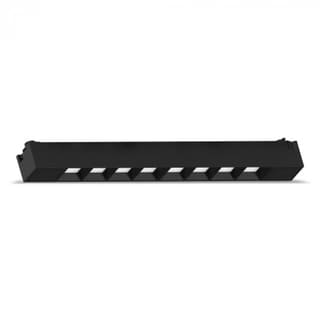
The beam angle sets the role of a spotlight: 15–24° — an accent on a picture, a shelf, a plant; 36° — a work area, a table; 60° and wider — a general wash of light. 2–3 wide spotlights for the background and 2–3 narrow ones for accents are more interesting than five identical ones. Linear modules of 30–60 cm give even light over a table or a kitchen island.
For walls and pictures the track runs parallel to the wall at 0.6–1 m from it, with the spotlights tilted at 30°: the light “washes” the wall without glare. General lighting in a rectangular room comes from a U-shaped or rectangular layout 0.8–1.2 m from the walls. The simplest option is a straight track along the room with adjustable spotlights: both background and accents.
The luminaire spacing is 0.8–1.2 m with a 2.7 m ceiling. Less than 0.5 m gives a jumble of light, more than 1.5 m leaves dark gaps. Leave 20–30 % of the track length free in case the furniture is rearranged.
See in the catalogue
Feron
20 Вт · 4000 K · 230 В
Horoz Electric
6 Вт · 4200 K · 160–265 В
LED Story
30 Вт · 4000 K · 180–250 В
Feron
60 Вт · 4000 K · IP40
Feron
20 Вт · 4000 K · 230 В
Horoz Electric
6 Вт · 4200 K · 165–265 В
The Light
10 Вт · 6500 K · 220 В
Buying guides
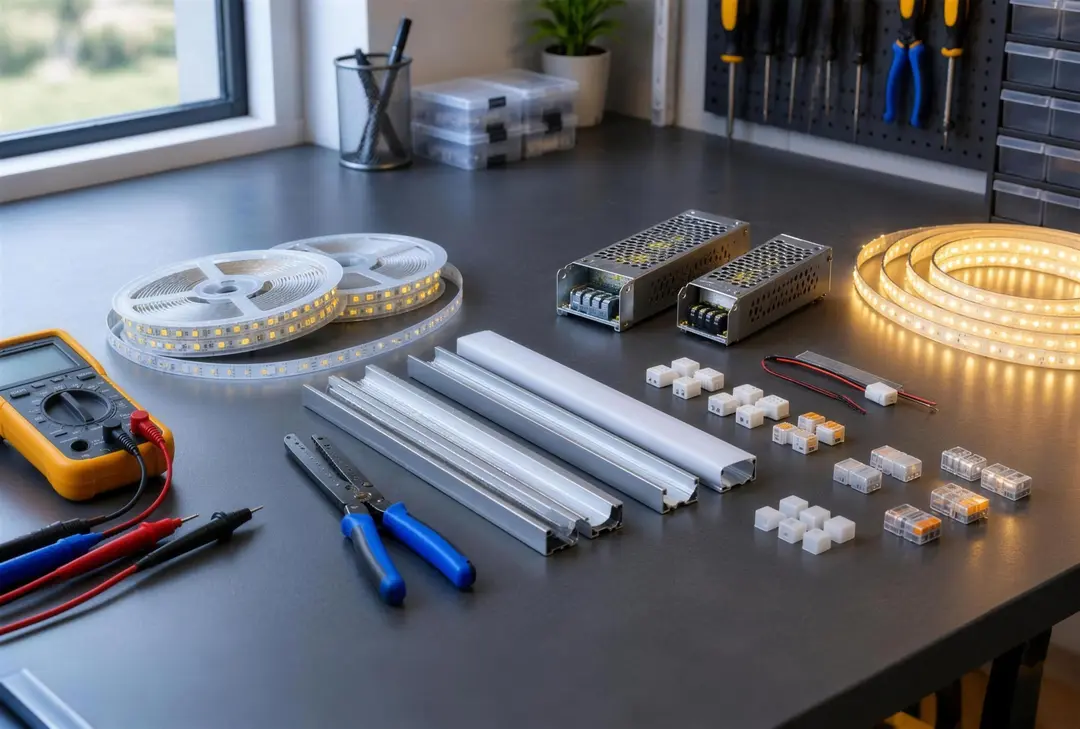
Half of all “burnt-out strips” come down to the wrong power supply. The difference between constant voltage and constant current, power with a 20 % margin, the housing for the mounting location and when it is worth paying for Mean Well.
Read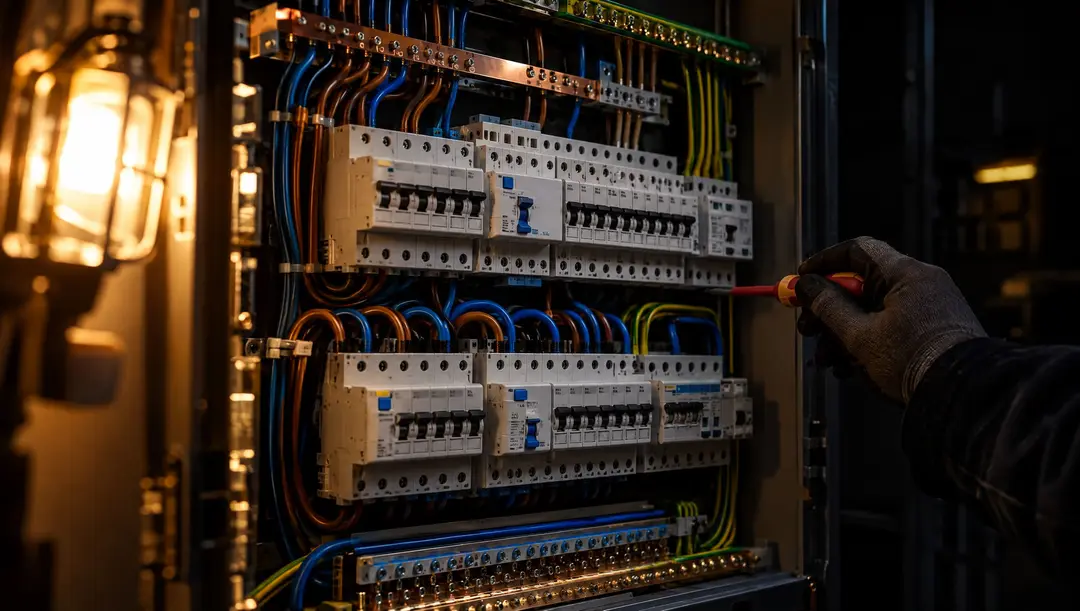
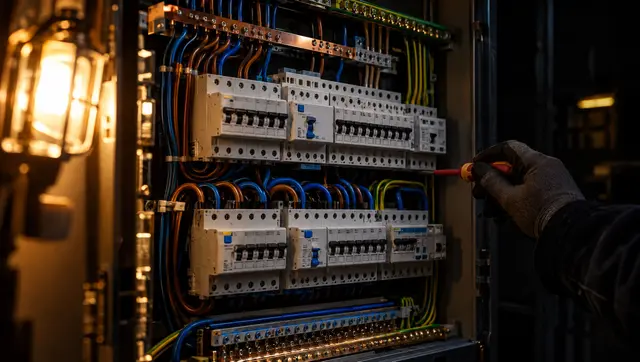
A breaker protects the cable, not the appliance: so its rating is chosen for the cross-section of the circuit, not for the power of the load. Below: curves B, C and D, a conservative “cross-section — breaker” table for copper wiring, 30 mA RCDs for damp areas and an example switchboard for a flat.
ReadContact